Cloud computing is transforming how businesses build, host, and manage digital services. From personal blogs to enterprise applications, cloud hosting provides the flexibility, performance, and security needed in today’s competitive online world.
Among all cloud platforms, Amazon Web Services (AWS), Microsoft Azure, and Google Cloud Platform (GCP) remain the three biggest players in 2026. Each provider offers reliable infrastructure, advanced networking, powerful security tools, and scalable resources, but they are designed with different users and business goals in mind.
This guide explains the strengths and weaknesses of each provider so you can confidently choose the best cloud hosting platform for your website or business.
Why Cloud Hosting Matters in 2026
Traditional hosting solutions often struggle during traffic spikes and require expensive hardware upgrades. Cloud hosting solves these problems by distributing workloads across multiple servers.
Businesses are moving to the cloud because it offers:
- Better website speed
- Reliable uptime
- Flexible resource scaling
- Strong cybersecurity
- Lower maintenance costs
- Global accessibility
- Pay-as-you-use billing
Whether you’re launching an online store, hosting business software, or creating AI-powered applications, cloud hosting provides the flexibility to grow without worrying about physical infrastructure.
Amazon Web Services (AWS)
Amazon Web Services continues to be the world’s largest cloud platform, serving millions of customers in more than 190 countries. Since its launch, AWS has built an extensive portfolio of services covering computing, storage, networking, databases, artificial intelligence, analytics, and application development.
Many of the world’s largest companies trust AWS because of its mature ecosystem and unmatched scalability.
Popular AWS Services
- Amazon EC2 for virtual servers
- Amazon S3 for cloud storage
- Amazon RDS for managed databases
- AWS Lambda for serverless applications
- CloudFront content delivery network
- Amazon Bedrock for generative AI
Advantages of AWS
AWS offers one of the largest global infrastructures with data centers located around the world. This ensures fast performance and high availability for international businesses.
Its extensive service catalog allows organizations to build almost any type of cloud solution without depending on third-party providers.
AWS also provides advanced monitoring, automation, backup, disaster recovery, and security tools suitable for businesses of every size.
Drawbacks
AWS pricing can become complicated because each service has different billing options. Beginners may also need time to understand the platform due to its large number of features.
Microsoft Azure
Microsoft Azure has become the preferred cloud platform for organizations already using Microsoft products such as Windows Server, Microsoft 365, SQL Server, and Active Directory.
Azure focuses heavily on enterprise customers by providing excellent hybrid cloud solutions, allowing businesses to combine on-premises infrastructure with cloud resources.
Popular Azure Services
- Azure Virtual Machines
- Azure SQL Database
- Azure Blob Storage
- Azure Kubernetes Service
- Azure AI Services
- Azure Backup
Advantages of Azure
One of Azure’s biggest strengths is seamless integration with Microsoft’s software ecosystem.
Businesses already using Microsoft products can migrate more easily while keeping existing workflows intact.
Azure also provides industry-leading compliance certifications, making it an excellent choice for financial institutions, healthcare providers, educational organizations, and government agencies.
Its hybrid cloud capabilities allow businesses to modernize gradually instead of replacing their entire infrastructure at once.
Drawbacks
Azure’s management portal contains many enterprise-focused features that may feel overwhelming for small businesses or first-time cloud users.
Google Cloud Platform (GCP)
Google Cloud has become increasingly popular among developers, technology startups, research organizations, and AI-focused businesses.
Because Google Cloud runs on the same global infrastructure as Google Search, YouTube, and Gmail, it delivers impressive speed and network reliability.
Popular Google Cloud Services
- Compute Engine
- Cloud Storage
- Google Kubernetes Engine
- BigQuery
- Vertex AI
- Cloud Run
Advantages of Google Cloud
Google Cloud is widely recognized for its artificial intelligence and machine learning capabilities.
Businesses developing AI-powered products benefit from Vertex AI, natural language processing, image recognition, and advanced analytics tools.
Google Cloud also provides competitive pricing with automatic discounts for long-running workloads, making it attractive for startups and growing businesses.
Developers appreciate its clean interface, modern tools, and strong support for Kubernetes and container-based applications.
Drawbacks
Although Google Cloud continues to grow, its ecosystem remains smaller than AWS. Some enterprise-specific services are not as extensive as Microsoft’s offerings.
Performance Comparison
Performance plays a major role in cloud hosting.
AWS delivers excellent uptime through its massive global infrastructure.
Azure performs exceptionally well for organizations running Microsoft workloads and hybrid cloud environments.
Google Cloud offers outstanding network performance thanks to Google’s private global fiber network, reducing latency for users around the world.
All three providers deliver enterprise-grade performance when configured correctly.
Security Comparison
Security remains a top priority for cloud providers.
AWS includes identity management, encryption, security monitoring, and threat detection.
Azure provides Microsoft Defender, Key Vault, identity protection, and comprehensive compliance solutions.
Google Cloud uses encryption by default, Zero Trust architecture, Cloud Armor, and advanced security monitoring.
No matter which provider you choose, following security best practices is just as important as selecting the platform itself.
Pricing Overview
Each provider uses a pay-as-you-go pricing model.
AWS offers flexible pricing but requires careful cost monitoring.
Azure provides discounts for businesses already invested in Microsoft’s ecosystem.
Google Cloud keeps pricing relatively simple and includes automatic sustained-use discounts that reduce costs over time.
Businesses should estimate expected workloads before selecting a pricing model.
Which Platform Fits Your Business?
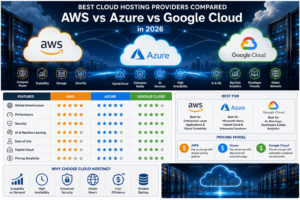
Choose AWS If:
- You need maximum scalability.
- Your business serves customers globally.
- You require hundreds of cloud services.
- You want long-term enterprise flexibility.
Choose Azure If:
- Your organization already uses Microsoft software.
- Hybrid cloud is important.
- You need enterprise compliance.
- You manage Windows-based infrastructure.
Choose Google Cloud If:
- AI and machine learning are business priorities.
- You’re building cloud-native applications.
- You want simple pricing.
- Your team prefers modern development tools.
Future of Cloud Hosting
Cloud technology continues to evolve rapidly. Artificial intelligence, automation, edge computing, and serverless architecture are becoming standard features rather than optional services.
Businesses that invest in cloud platforms today will benefit from improved scalability, stronger cybersecurity, lower operational costs, and faster innovation in the years ahead.
As AI adoption increases, providers such as AWS, Azure, and Google Cloud are expected to release even more intelligent services that simplify application development and business operations.
Conclusion
AWS, Microsoft Azure, and Google Cloud remain the leading cloud hosting providers in 2026, each offering reliable infrastructure and enterprise-grade services.
AWS stands out for its extensive ecosystem and global reach. Azure is the ideal choice for businesses using Microsoft technologies and hybrid cloud environments. Google Cloud excels in artificial intelligence, analytics, and developer-focused innovation.
The right choice ultimately depends on your business requirements, budget, technical expertise, and future growth plans. By comparing features, pricing, security, and performance before making a decision, you can select a cloud hosting platform that supports your organization for years to come.